How to Become Sin-Less
hitting the mark of love

Many of us inherited a version of sin that sounds like this:
“Sin breaks God’s heart. Break the rule. Trigger the penalty.”
Sin became a to-do-list failure
or worse
a “better watch out” list.
And Scripture, rather than breathing life, became a compliance document.
But Jesus uses a very different framework.
Not law first.
Not punishment first.
Love first.
(Here’s an article on LOVE to read next)
The Word Study: What Sin Actually Means
The most common New Testament word translated sin is the Greek word hamartía (ἁμαρτία).
It does not mean:
breaking a rule
violating a regulation
failing a moral checklist
It means:
to miss the mark
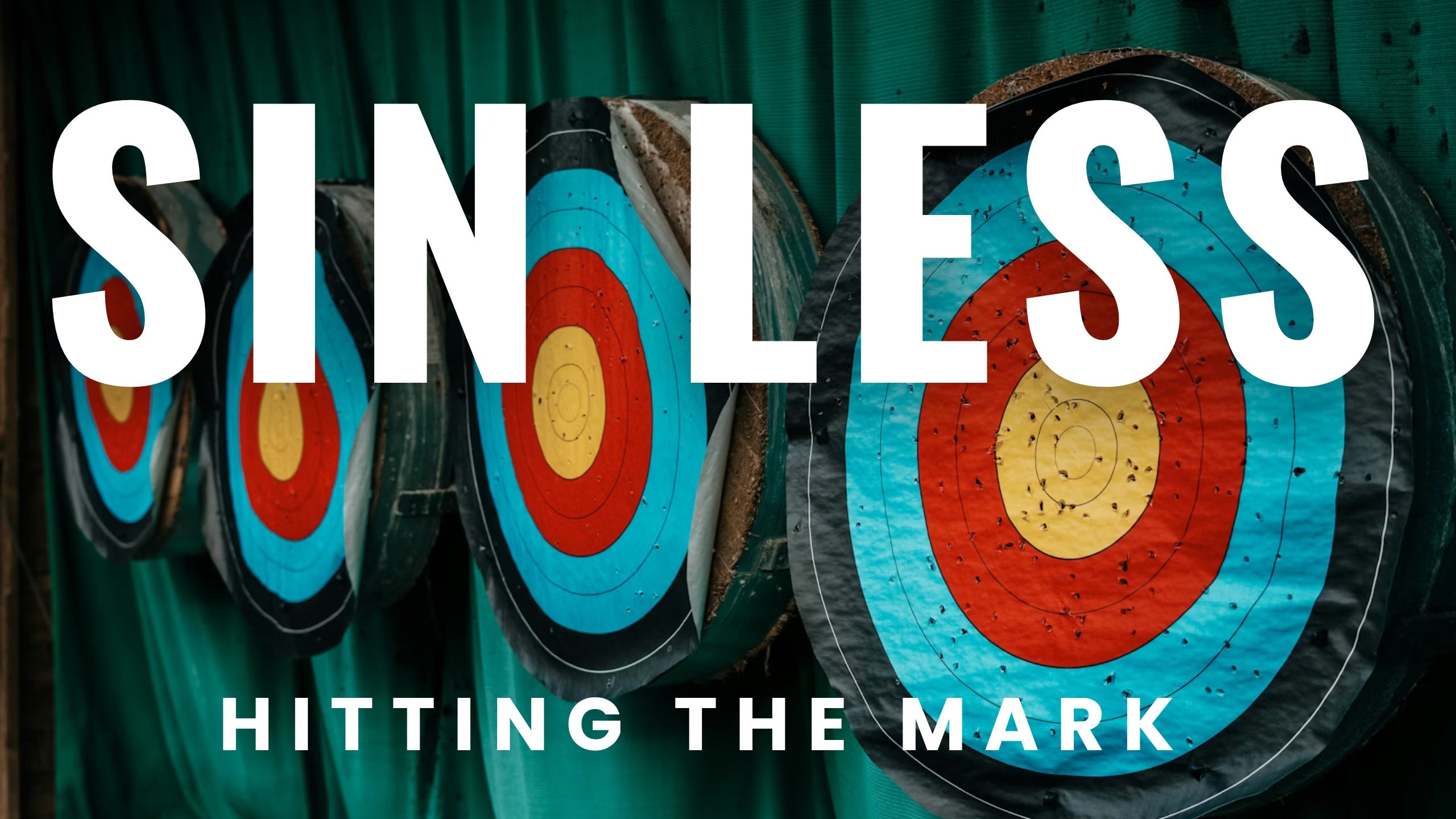
The word comes from archery.
You aim.
You release.
You miss.
Not rebellion.
Not defiance.
Misalignment.
Which immediately raises the real question:
Since sin is missing the mark - what is the mark?
The Text Tells Us What the Mark Is
35 And one of them, a lawyer, asked him a question to test him. 36 “Teacher, which is the great commandment in the Law?” 37 And he said to him, “You shall love the Lord your God with all your heart and with all your soul and with all your mind. 38 This is the great and first commandment. 39 And a second is like it: You shall love your neighbor as yourself. 40 On these two commandments depend all the Law and the Prophets.” Matthew 22
The test was not to see if Jesus knew Torah - but to see which school of thought he stood on. There were two schools - the houses of Hillel and Shammai
Both schools agreed with the first command Jesus quoted. Where they differed was the second command.
Shammai represented strict, conservative interpretation - rigorous and uncompromising, building high fences around the commandments through separation. They quoted the second command as, “Keep the Sabbath.” In other words a legalistic approach.
The House of Hillel took a more lenient, inclusive approach - finding room for mercy, creating pathways for peace rather than conflict. They held to the second command as “love your neighbor as yourself.”
Jesus placed himself squarely in the camp of Hillel. The house of love.
The mark is love.
Sin is what happens when love is missed. Love is the bullseye.
Sin literally means to do something that is unloving toward God, toward another, toward yourself.
Not because God is counting failures
but because love is the point.
THE point.
How Sin Got Reduced to a Fear of Rule-Breaking
When sin is framed as rule-breaking:
Scripture becomes legal code
God becomes an enforcer
Love becomes a means to avoid punishment
That framework trains people to ask:
“Is this allowed?”
“Where’s the line?”
“How close can I get without crossing it?”
“If I do something wrong am I going to hell?”
That’s not spiritual maturity.
That’s moral minimalism.
Jesus didn’t come to produce better rule-followers.
He came to form loving people.
Love Is Not a New Legalism
Here’s the danger when people reinvent the law of love:
They turn love into a dangerous law.
“You must be loving… or else.”
But love doesn’t function under coercion.
Love is responsive, not regulated.
Relational, not rigid.
Alive, not audited.
The goal isn’t to try harder to love.
The goal is to become so attuned to love
that unloving actions feel off.
A Healthier Way to Relate to “Sin”
A spiritual understanding of sin doesn’t produce fear.
It produces awareness.
Think about how love already works:
When someone ignores you, you feel it.
When someone lies to you, something tightens.
When someone speaks with contempt, it lands heavy.
You don’t need a rulebook to know something’s wrong.
Your body knows.
Your spirit knows.
In the same way:
Sin becomes whatever disrupts love
and we become bothered by it
the same way we’re bothered by being unloved.
Not condemned.
Not shamed.
Disrupted.
Sin as Invitation, Not Accusation
When sin is understood as missing the mark of love:
Repentance becomes recalibration of the mind, not groveling
Conviction becomes clarity, not condemnation
Transformation becomes relational, not performative
You don’t repent because you’re bad.
You repent because you want to love well.
And love - real love
always invites alignment.
A Different Question to Ask
Instead of:
“Is this a sin?”
What if the better question is:
“Is this loving?”
Toward God.
Toward others.
Toward myself.
That question doesn’t shrink your life.
It expands it.
Because the goal was never rule-keeping.
The goal was, and still is,
love lived fully.
And that is how we become sin less.
Peace,
Paul
I write about the life spoken of in John 10:10 - “The thief comes to steal, kill, and destroy. I have come that they may have life and have it to the full.” In this article the thief is anything that is unloving.
P.S. — If this landed, forward it to someone who may feel the weight of sin under the wrong definition.
QUESTions to Sit With
When you hear the word sin, what do you feel first - fear, shame, indifference, or grief? And where did that feeling come from?
Does “breaking a commandment” make you feel watched… while “missing the mark of love” makes you feel aware? Which one draws you toward change, and which one makes you want to hide?
When you’ve acted in a way that wasn’t loving, what disturbed you more afterward: the thought of being wrong, or the sense that it was unloving?
If sin is missing the mark of love, where in your life right now does love feel thin, strained, or withheld, not because you’re bad, but because you’re human?
How would your relationship with God change if repentance felt less like an apology to authority and more like a return to love?
What behaviors have you avoided out of fear of sin… that you might release naturally if love, not law, were your guide?
What would it be like to trust that your growing sensitivity to love is actually a sign of spiritual maturity, not moral weakness?